


Sauna, My Happy Place
I do this ritual quite often, and it brings me quiet and peace. Sauna has become my happy place. I can relax for two hours, enjoy myself, and just breathe. Going in the morning to a public sauna gives me a private feeling.
I lie on my back or my side in this happy, almost-dark space. Dim lights. Sometimes gentle meditative music. The warm rumble of the heater. Many times I am alone. I can be with my own thoughts and let my body soften into the heat. And I am even sweating, wow. Even my legs!
Sometimes I get into a state where I really sync with the heat and humidity, and I can stay there for a long time, unless my body starts complaining about the still not-so-comfy wooden slatted sauna bench, the kind most Finnish-style saunas have. At least my head is now supported with a towel.
After I step out and rinse the heat off, I snuggle into my pink bathrobe, hide my legs in a towel, and lie down on a (this time actually) comfortable lounger in the resting room. It is dim again. There is quiet, maybe soft background music. I can be alone with my thoughts and feelings, warm and safe, drinking water with mineral drops.
And once I feel even cozier, I go back to my favorite tropical sauna again. It feels so good to be there. It does not matter how long I am inside, or how long I am outside in the quiet resting room. I do it by feel. It gives me the sense of a safe space.
I can go so deeply into my own experience that I do not mind other people around. With my wired-differently eyesight, I cannot tell a man from a woman in that darkness without my glasses anyway. Sometimes I go with girlfriends and we have a hard time not breaking the silence rule because we always have so much to talk about. That is when my sauna ritual becomes social. Even then, it still gives me warm, relaxing time.
Sauna used to be sensory hell for me. Now it is one of the most regulating places I know, because I stopped following generic rules and started following my body.
Rewind to Last Year
If you rewind my life back until last year, you get a completely different situation.
I would go to the sauna because it was “nice” and it was supposed to mean relaxation. I had to go with someone because I do not see a thing without my glasses on, so I needed someone to make sure I would not sit on someone else’s lap (Friends reference intended). And I needed someone to tell me how many more minutes to stay, based on the little sandglasses on the wall.
No matter what type of sauna I entered, my face immediately burned and I could not breathe properly. Sweating? No way, just overheating and burning. And I never understood the hard, straight surface I had to “rest” my body on. It felt designed for the shortest stay possible. After only a few minutes I would escape dizzy, my head spinning for a long time in the resting room. And the cold pool? I know it should be part of it, but the reality felt impossible.
Both versions are lived experiences of a highly sensitive woman. The difference is not willpower. The difference is customization.
What Made Sauna Finally Click
The last time I was in the sauna, I caught myself thinking about how many positives it brings me now, and how I could write about it in a way that suits highly sensitive people. It can be so soothing and calming in there. It has become genuinely supportive for me.
So I researched it. For my topics there is usually very little research, and sauna for HSPs is no exception. Still, I want to share what I have, plus what my own body has taught me, especially about personalizing sauna based on sensory needs and cycle phases. Because I know how uncomfortable it can feel but also how soothing and relaxing it can actually become.
This is for you who think they don’t like it.
For you who has chronic back pain.
For you who needs quiet rest in the dark place.
For you who wants to passively become healthier, more relaxed, improve your circulation, be with your own thoughts and be fully present with your body.
Sauna for HSPs: A Good Idea or a Sensory Trap?
Here is the honest answer. It depends on the variables.
What can work beautifully for an HSP:
low sensory load, dim light, quiet, predictable environment
eyes closed, fewer social demands
built-in recovery time in the resting room
warmth when you are cold and braced
a ritual that gives your nervous system a clear boundary around rest
What can go wrong fast:
heat that is too intense for your body that day
too many people, too much proximity
hard flat surfaces
steam that feels heavy, or dry heat that feels sharp
staying too long and leaving too quickly, which can lead to dizziness
the hot-to-cold contrast, which can be too much for sensitive bodies
I get it. A lot of these things are hard for many people too, and for highly sensitive ones this can turn into a nightmare fast. My view is simple. Once I found my ideal sauna style, I stopped feeling like I had to “tolerate” it.
For me, that ideal is around 50 to 60°C with moderate humidity, around 50 to 60%. I also learned how long I can stay, and that number changes. It depends on my cycle day, my overall state, the weather outside, and how sensitive my nervous system feels that day.
Originally, I could not imagine myself alone in a sauna full of strangers without my glasses. My body refused to sweat, so my face and limbs were just on fire. Cold water was out of the question.
Now I have a rhythm.
The Rhythm That Works
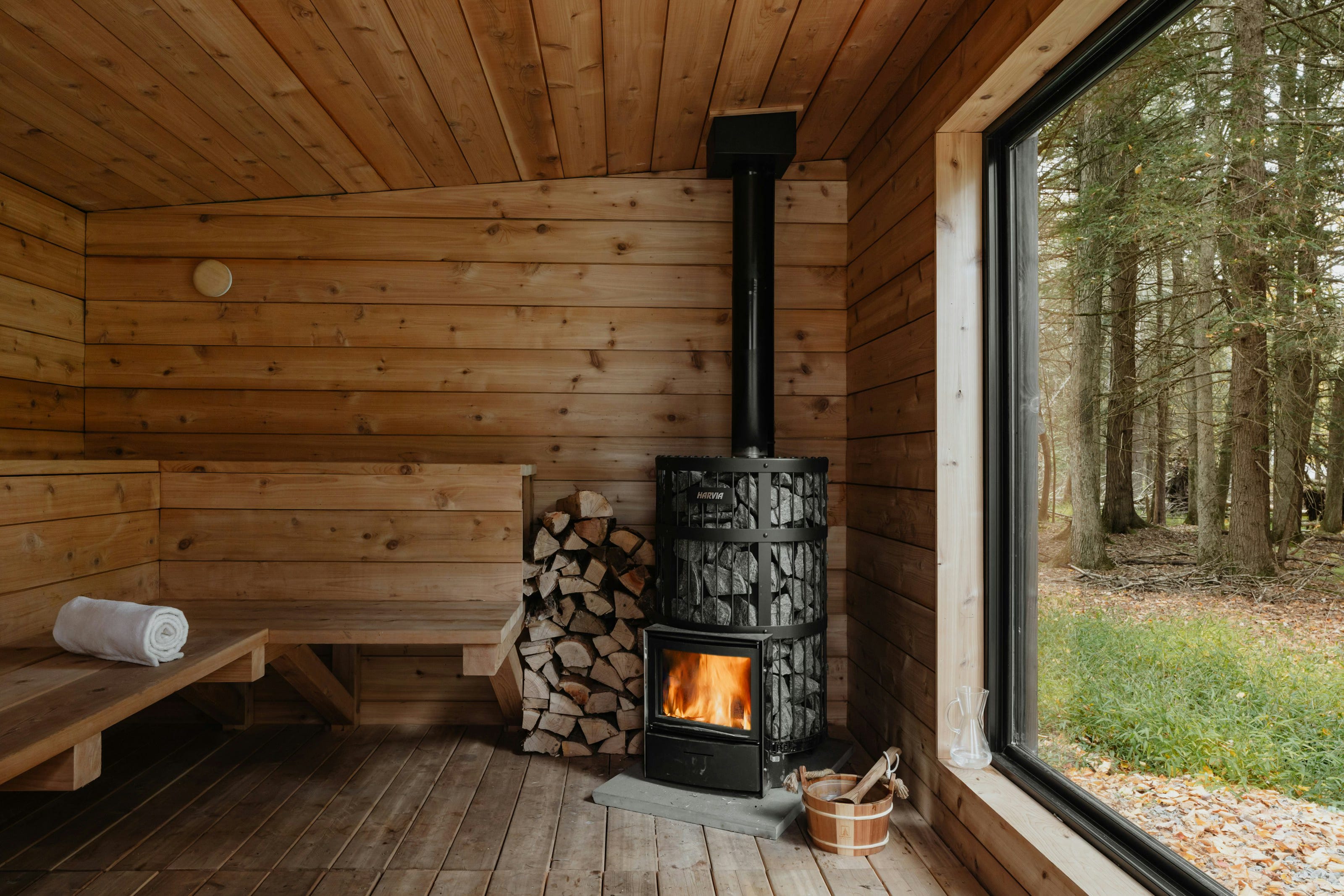
I choose the kind of heat that feels gentler for my body, and I let the environment do some of the regulating for me. When I can, I go in the morning, when it is quieter and the whole space feels less like a performance. I also accept that my sauna experience is sensory, not social. Some days I want quiet. Some days I bring friends and we try very hard to whisper less.
Before I go in, I dry brush. It marks the shift into the ritual and helps my body feel “on board” with what is coming. It helps wake up my skin and my circulation, and I start sweating more easily. Once I am inside, I lie down. It is much better for my head to not get overheated. I keep moving between positions, on my back and on my side, and I check in with myself often. Can I still breathe easily? Does the heat feel nourishing, or does it feel sharp? Am I starting to feel comfortable or the opposite? Am I able to focus on anything else than my physical experience? I have learned that my body gives me a clear answer long before dizziness or overheating shows up.
When I am ready to leave, I sit up first. I give my system a moment to catch up with the change, especially because I used to rush out and wonder why the spinning started. After the heat, I rest. I drink mineral water. The shower temperature is something I decide in the moment. The cold pool is optional. Some days it feels amazing. Some days it is simply too much. And everytime it is just a few seconds for me: in and straight out, my head above the water surface.
This is what changed everything for me. I stopped trying to do sauna “the right way.” I found my own way and a few small rituals that make it genuinely pleasant.
Cycle as a Variable
There is not much solid data on sauna timing across the menstrual cycle, at least not in a way that feels practical for everyday life. So I will share this as my personal pattern, not a prescription.
During my menstrual phase, I skip sauna. In the follicular phase after menstruation, and often around ovulation, I tolerate heat more easily. In the luteal phase, especially with PMS, heat can feel intense and overwhelming, so I shorten the whole ritual or skip it. That is not a failure. Not a contest. That is information.
My cycle is one of my main variables, along with sleep, stress, mood, weather, and how porous my nervous system feels that day. Listening to that has made sauna feel supportive instead of punishing.
What the Research Suggests
Even though there is very little written specifically for highly sensitive people, sauna research in general is surprisingly rich. The big studies tend to come from Finland, where sauna is part of the culture, and many of them link regular sauna bathing with better long-term health outcomes. The language is careful because a lot of this research is observational, but the patterns are still interesting. More frequent sauna use has been associated with lower cardiovascular risk and lower overall mortality in large cohorts, and some research has also linked sauna habits with lower dementia and Alzheimer’s risk in the populations studied. Beyond the long-term associations, there are also studies on passive heat exposure that suggest improvements in blood pressure and vascular function for some groups, which makes sense when you think about what heat does to circulation.
There are also links, in observational research, between sauna habits and lower risk of certain respiratory illnesses over time, which matches the everyday stories many regulars share about getting sick less. On the pain side, heat is a classic ally for things like low back pain. Even menstrual pain has a relationship to heat therapy in clinical research, although those trials often use localized heat rather than a whole sauna session.
Warmth can downshift stress, soften pain, and support sleep for many people. For some bodies, warmth regulates more easily than cold. I hear this a lot from other women.
The One Thing I Still Complain About
One con I still struggle with is the uncomfortable surface of many saunas. My body is highly sensitive when it lies or sits for even a few minutes on almost any surface without movement. Those wooden slats can feel like a sensory test I did not sign up for.
Why can’t saunas have the kind of loungers some spa resting areas have? The ergonomic, wave-shaped heated loungers, often finished in mosaic tile, gently contoured so your neck is supported, your legs are elevated, and your body can truly rest without bracing.
Maybe one day I will find a sauna designed by someone with a sensitive nervous system.
Following Your Body Changes Everything
I know sauna can feel like a sanctuary for one person and a sensory overload for another. Even for the same person, it can change week to week. Type of sauna, temperature, humidity, company, cycle phase, how you slept, how much you have been holding all day. It all matters.
For me, the win was learning the settings where my body can exhale. And once that happened, sauna stopped being a challenge and became a place I return to when I want to feel safe and warm again.
I would love to hear how sauna feels for you, and whether you have any little hacks that make it a good experience.